top of page
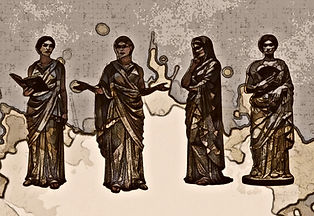
Four_virtues.JPEG
6 days ago
6 min read

AI Might Swallow Us Whole, But Let It Be a Writer's Playground Until Then.

Dr. Christine D. Allen, 10/7/2026

Playtime, Take 1: What Does AI Hear in Your Writing?

What if you could hand your writing to a reader who had no agenda, no history with you, no reason to flatter you—and ask, "What do you hear in this?" Not whether it's good. Not whether it deserves to be published. Not even whether it's likable. Just: *What kind of voice is this?*

That is one of the more interesting games I've found to play with AI.

I know. I can already hear objections. "Your voice is yours. Why would you hand it over to a machine?" Worse, why would you let a machine describe something as intimate and slippery as your creative voice? There is a real danger here. If we start asking AI to tell us what our writing sounds like, we might begin writing toward the machine's description of us. We might sand off the strange edges, correct the contradictions, or mistake a pattern for a prescription. But there is another possibility, and that is the one I'm interested in:

AI can be a remarkably useful mirror precisely because it isn't us.

When I asked AI to analyze my writing, I wasn't asking it to tell me who I am as a writer. I was asking it to notice what I couldn't easily notice from inside my own head. It pointed to things I recognized immediately—my tendency to move by association rather than explanation, my use of humor as a pressure valve, my habit of letting metaphor become part of the thinking rather than merely decorate it. It also gave me language for patterns I had felt without naming. That distinction matters.

The useful question isn't whether AI can understand your voice.

A reasonably good outside reader can help. So can a writing group. So can an editor. But those readers have their own histories, tastes, fatigue, preferences, and limited time. AI offers something different: an endlessly patient reader willing to look at several pieces of your work and ask, "What keeps happening here?" That doesn't make its answer authoritative. It simply makes the answer interesting. And that's where I want to keep AI: not as the writer, not as the judge, not as the keeper of the One True Voice—but as a playground companion who can point at something on the page and say, *Hey. Do you notice that you do that a lot?*

Sometimes the most useful thing another intelligence can give a writer isn't an answer. It's a mirror.

So, for this first bit of playtime, I decided to see what would happen if I gave AI some of my writing and asked it to tell me what it heard, then share it. If you decide to try it and want to share it, please leave your analysis in the comments. The following is authored by ChatGPT, because today Gemini was being a little sourpuss and giving me slop. I was suprised by the output. If you've ever seen my creative works, you might understand why.

Your writing style, in a nutshell (from ChatGPT, analyzing my essay, "Speak from Your Diaphragm")

I would describe it as:

Intimate, associative literary nonfiction that moves by emotional and metaphorical connection rather than by conventional exposition.

You write as though the reader is inside the movement of your mind, rather than being told afterward what you thought. That is the most important characteristic I see.

1. You think on the page

Your prose doesn't pretend that the writer has everything figured out before beginning. You frequently let us watch the thought form, change, contradict itself, or derail. For example:

“But the truth is, I couldn’t remember, not exactly, because that’s how I forget at doctor visits.”

And then:

“I guess I can say be wary of what I do say, since likely I can’t remember or I remember otherly and I’m trying to piece together something for fear of nothing.”

That is not conventional exposition. It is thinking as performance. The reader experiences uncertainty rather than simply receiving a conclusion about uncertainty. That's powerful—and it's something worth preserving.

2. You use humor as a pressure-release valve

Your writing can move very quickly from frightening or painful material into something funny, absurd, or slightly obscene. For example, the doctor tells you there is a possibility of perforation. You respond:

“Aw. How romantic.”

Then:

“Well. Be gentle,” I said, and I felt like a very young girl saying something complicitous, something sweet and horrific.

That juxtaposition is extremely characteristic. You don't make humor a separate “comic section.” The humor emerges from the horror. And because you don't announce the joke, the reader has to catch it. That's a sophisticated technique.

3. Your metaphors don't decorate the prose. They become the prose.

This may be your strongest stylistic characteristic. You don't typically write:

I was confused.

You make confusion physically occupy the world.

One of my favorite examples is:

“All is slow. I try to form words but the words are pebbles at the bottom of the stream…”

Then the imagery keeps transforming: water, grassy hills, foam, rooms, space, bodily pain. The metaphor isn't an illustration of the experience. The metaphor becomes the experience. Later, you do something similar with the ceramic woman. The sculpture becomes simultaneously an object, a body, an illness, a self-portrait, and a repository for fear and hope. That suggests something important for our future work: Your best nonfiction probably shouldn't merely explain an idea. It should find a physical or concrete image through which the idea can be experienced.

4. You make surprising conceptual leaps

Your mind moves associatively.

  • From colonoscopy to risk of AIDS.

  • From medical specialist to jokes about proctologists.

  • From medication to hallucinated scenery.

  • From ceramics leads to contending with illness.

  • From vampires to autoimmune illness, guilt, children, paralysis, and the desire to stop moving.

These connections aren't random, even when they initially seem random. They are connected by emotional logic rather than logical exposition. For example, the vampire passage begins with:

“I think I know, finally, why so many people are infatuated with vampire stories.”

And then the vampire becomes a metaphor for exhaustion, illness, guilt, isolation, and the inability to stop living. That is very different from an analytical essay that says, “Vampire stories can be interpreted as metaphors for illness.” You inhabit the metaphor.

5. You aren't afraid of fragmentation

Your sentences sometimes break apart. You use fragments. You repeat words. You interrupt yourself. You change tense. You occasionally let grammar bend around the experience. For example:

“So, yeah. Colonoscopy.”

Or:

“And ought not. The children, after all.”

Or:

“Who? I’m all over the place, and can’t imagine who I might be.”

These aren't grammatical mistakes in context. They are rhythmic representations of consciousness. Your prose therefore has a strong oral quality. It would actually work very well being read aloud.

6. You use repetition differently from conventional academic writing

You repeat words and ideas to create emotional pressure. For example:

“I was raped, raped, raped, and then once more. Survived. Stalked. Survived.”

That's not repetition for emphasis in the ordinary rhetorical sense. It feels more like someone trying to make language contain an experience that language isn't really capable of containing. You also repeat:

“after all, after all”

and:

“I survived.”

The repetition creates rhythm and insistence.

7. You have a strong instinct for the grotesque and the beautiful existing simultaneously

This is another major signature. You put:

  • medical instruments,

  • hives,

  • bodily fluids,

  • colonoscopies,

  • disease,

  • death,

right beside:

  • petunias,

  • children,

  • ceramics,

  • snow,

  • sunlight,

  • beauty.

And you don't necessarily resolve the contradiction. The final image is particularly characteristic:

“Walking back to my car, I see the sun shining on the snow.”

And eventually:

“Hey, girl, the colon’s just a colon. A cell is just a cell. I am just here, driving myself home.”

That's a beautiful example of your tendency to return from abstraction to an ordinary physical moment.

8. You are deeply self-aware—but you don't protect yourself

There is a striking absence of self-presentation. You don't seem particularly interested in making the narrator look wise, heroic, composed, or even consistently likable. You admit confusion. You make jokes at inappropriate moments. You expose contradictory feelings. You acknowledge embarrassment. You sometimes make yourself ridiculous. And then you keep going.

For example, after getting the handicapped parking pass, you write:

“And then I get the pass. I am humiliated.”

Then immediately you compare yourself with veterans and another woman from pottery class and feel guilty about taking the parking space. That vulnerability gives the narrator considerable credibility.

9. Your sentences alternate between long associative movement and blunt little punches

This is an important rhythmic feature. You might have a long, winding sentence full of clauses and images. Then:

“The rest recedes.”

Or:

“I am humiliated.”

Or:

“They laugh.”

Or:

“I survived.”

Those short sentences act like stones dropped into water. They give the reader somewhere to land.


Recent Posts

See All

Comments


Possible Prologue: She Can't Be Shaved (And Requires No Shaving)

The sad big-boned mother of two is not Pandora, in that her desire to open the box—the deep-throated compulsion that gives her thoughts a discomfiting tingle—isn’t driven by curiosity, but a wish. It has something to do with an uncertain trudge through the spolia of a fits-and-starts life, one that has reduced her to little more than an urge to condense in on herself so compactly, so completely, she might burst into immeasurable, nothing-feeling, aimless bits. She knows what’s inside the box, doesn’t she? 

​

Must she? 


Her hippocampus—that lost little seahorse—has given her the gift of forgetting. Why should she betray it? 

The box is not Pandora’s box, or jar, for that matter. Its contents are not entirely unknown. Also, it’s not the box of man but of one. Person. This, Christine’s box, wasn’t given to her by Zeus but bought at the Messy Closet for seven dollars and eighty-eight cents to serve as a planter on her porch. But she doesn’t have a porch. Not anymore. She’s been running and hiding with her daughters for some years now. 

​

[Dweep] 

​

What is that sound? We know that sound. 


Once, or maybe several times, she dug the box up from its hidey-hole near the left fork of Bristlecone Creek. She’d sat on a boulder and held her face with long blackening fingers. Why should she open the box? There couldn’t be anything in there she needed badly—she was surviving all right. She wasn’t in-shelter anymore, not really. She had nuts and chocolate and a half of a sandwich, a bottle of water, a notebook. She even had extra socks and a thin faux-fleece blanket she stole leaving some flight or another. 

​

Don’t forget the cigarettes, the lighter, the pen. 

​

Yes, and a pack of Pall-Mall menthols, the long ones. Or, hundreds. And she hadn’t opened it. The box. Curiosity kills the cat and so on. Now, in a late-afternoon chill, under boughs of trees and surrounded by grasses and thistles and bluebells and clematis, she once again passes a jagged fingernail packed with earthy blood over— 

​

I prefer bloody earth. 


—packed with earthy blood, thank you, over the linen-like surface of the box o’ reckoning and considers what to do with it. 


[Dweep] 


She could take it home, douse it in stain remover, and scrub. She could put it in the apartment hall for someone to pick up—someone who might think, in all that chic sickly-sweet emptiness of the North Sixth Apartments that welcomes the resident elevator-exitor, Ooh, we could use a box. For a planter. For miscellaneous and useful forgotten things. For makeup palettes that, over the years, have colored one another a leveling and dusty mauve. And if no one took it, that seemingly innocent and empty box, the surly maintenance man would haul it to the dumpster and she’d never know the difference. 


[Dweep] 


She could still tell herself the preferred story, because stories of serendipity, however minor, have their own beating hearts and leathery wings. But she knows better. This particular box, not much larger than a boot box but looking more like a small suitcase with its tarnished brass buckles, is full of stories—her stories—of survival, of death-in-life, of dumb mischief, despite. 


Despite? 


It all. Interruptions. Ruptures. Raptures. No one else can release them; they’re not their stories. And what would anyone want with narratives of a no one who is or was or will be nowhere in particular? 

​

[Dweep] 


Couldn’t she start anew, outside of the box, entertain herself for the remainder of her life sentence? She could put old stories to rest before their purveyor’s time; no one would notice the difference. 

​

You would notice. 


She would not. Not necessarily. She forgets things. 

​

We buried that box for good reason. You know it and I know it. 


She’d buried all that adrenal-fermented terror, all right— 


[Dweep] 

​

—and she could open up, depressurize the space there, and bury it again. But she’d heard a rustling somewhere in those shady pines, those yawning stands of aspen (a prowling mountain lion if she could choose her predator), or a seismic rumbling from the dark animal earth. Run, she’d thought. And she’d returned the box to its hidey-hole, pushed the black soil back over it, and run. 

​

Where had we run to? 


It doesn’t matter. 


[Dweep] 

​

What matters is that here she finds herself once more, creekside, digging the baby-weight monstrosity back up. And the cuticles are cracked at nails’ edges and they hurt, and three fingers have been cut on sharp objects. And that should tell her something. 

​

Should it? Like what, for example? 

​

Like who or what she’d heard motioning there. Like…what she would have planted, had she a porch. Like, what loneliness feels like. Like the weightier stuff beneath the lonely. 

​

Oh, stop. What mattered was…? 

​

[Dweep] 


Was that the creek gurgled and chuffed and then there was movement in the grasses, in the brush, coming closer. The abrasive scent of a bank so full of charred bodies and ash-scarred rooftops and dead dogs, which, along with an inconstant light, had overwhelmed her, and the towhees and the crickets had whirred or screeched in response, a kind of madness escalating in her brutal ears: Wake up, wake up, wake up— 


Or someone or something, or just gravity itself, had smashed her head and heaved the box on her big-ribbed back, pushed her face well into some sediment more alluvial in composition, clutching or catching a fistful of her hair to push her deeper into a composite of angular things, sharp things, old- and odd-smelling things— 


[Dweep] 

​

And had come on her skin, as she’d reported to an officer in some other world. On the boundary or maybe in the boundless, between flux and the corpse in a library of inferences and implications, she couldn’t breathe, her mouth and nostrils so full of such muchness— 


Easy. In through the nose, two, three; out through the mouth, two, three, four. 


Or her face and also the black muck or a curiosity were inside the box, forming a bright green shoot, making its way out at first light from a well-worn corner— 

​

[Dweep] 

​

—a tiny tendril, by way of photosynthesis and inevitability, but the birds and the bees and the locusts and the trees had no message for her, only a trilling, a tempting. In this way she, too, rustled in a creep, inventing a lattice, inventing what it is to not die, a die-knot, and making the most of it. 

​

For a wakeful painful second she flashes in or out of Turkish, wishing for her overstuffed book bag, wanting to wish away a metallic breath in and out and in and out and a fall that ended presumably with a thud and a crack, but that second, that trellis, recedes like everything else. Eventually. Out of grasp. 

​

[Dweep] 

​

Or grasped from behind. 

​

Stop! Beside her is a what? 

​

Table with indistinct food on it. A monitor flashing and waving in relative darkness. 


Good girl. 


I am not a girl. I am not good. Don’t call me a good girl. 

​

How about a goodly girl? Or a girly good? 


A linen-like surface, making faces, this bed’s spread wadded up in the lower regions—it’s all heated, familiar, she’s felt that rabbit before, in a well-worn bluebellish gown. She knows it the way she knows any knowable knot. But the breath breathes the tinny and the face is fiery despite the bed or maybe the bed is on fire and she knows with equal ambivalence nothing is known outside of misfire. 

​

[Dweep] 

​

Synaptic twigs and bones and things. Hairline cracks or holes. Sights, sounds, soils. Falling, sickness. Where is she? When is she? When is she not in a box? 

​

Breathe, already. 


Dread the inhale, exhaustion the exhale. Face, wet. Head, throbbing. Blood? No. Bandage. 


Exhale then, let it pass. 


The buckles are brass. Dirty brass sealing shut a mess. Help me, thinks the thought. 


Who’s there? 


I’m here. We’re here. 

​

No one! Is here. 

​

[Dweep] 

​

Artemis? High-crowned figure of eggs, of animals—of stags and bees and things. Hands extended—as offering or reception? Broken fingers. Stubs of fingers she has. Christine looks but cannot or does not want to see. In a wakeful, painful, treeless recollection: a red, a museum. Selçuk. And there, in Efes, a buried harbor, a cave hole and a bag, a hole bag, the heaviest heart, word of her. “Help me,” she says, seeing her in rock but feeling her in waves, of daughters. 

​

Yes, daughters! 

​

An offering. A request. But she has no libation to pour, no Iphigenia to march to pyre. 

​

Why would Artemis want a sweaty sailor king to sacrifice her darling? 


Yes, why would she? There’s also a story of a woman, in a dimly lit room. 

​

[Dweep] 


Whose story is this? Where am I? 


Let’s talk about why this story is. 

​

Because I’m sad. 


You’re hiding. 


Stop. 


You’re hiding. 


I’m not. 


You saw someone at the Artemesium. 


Tourists. Just— 

​

A mother. On her knees. And you— 


Stop stop stop stop. 


You asked for protection for your children. 

​

[Dweep] 

​

Can you protect your girls here? Like this? 

​

A lowing. As if a birthing or a mourning; stifled, as if coming from the trunk of a tree or a hollow of harbor. Light is scarce, if imagined. Inconstant, still. She’s in a room on a bed or near a creek-bed box. Or she’s buried in a dirty chamber guarded by tiny black-and-gray spiders. In her live a hundred dead men—a thousand dead men—crawling out, crawling in. 


This is not your home! 


She doesn’t have a home. Not really. She’s homelessly homed. Does it matter where? 

​

What matters? What always matters most? 


A plane will light off! And if she’s not on it? 

​

[Dweep] 

​

She slips, thought to uncertain thought, where to when, or when to where. Either there’s nothing to open and no one to open up to, or she’s deep in bony boxness, buried in soot or soil or ash, wanting to make her way out. Who—who is she to open, and why—why should anything matter, to anybody? But to you, full of chastisement. 

​

I never chastise. I chastise sometimes. This is not that. 

​

The box is said to chaos. Or the said box, the saying of the box, evidence of a kind of tongue-tie. Now, lightless, she sees nothing, but senses a cliff or a rift or a landing. She hears nothing, maybe her ear has been boxed or maybe— 

​

[Dweep] 

​

She feels a crawling. She feels beaten. Maybe the shapely is not unlike linen—dirty. But let’s just suppose in juxtaposition there is something else—inside a silky, blackless night-lining, smooth— 

​

If you didn’t come for the library, then what? 

​

A jar. That box. If truth were told. What she is aware of— 

​

If awareness is— 

​

—is that she aches and her breath is some thin to stifled, and though it is so inky black back in this here jar-box— 


What are you afraid of? 

​

Nothing. 

​

[Dweep.] 

​

Everything. That depression will swallow her whole and she’ll live in its acidic belly until she unskins. Or she will live outside of it, unskinning all the same. That she’ll enter an asylum of her own construction and throw away the key or forget where she put the key, or fail to make sense of lock and key, that they belong together. 


You hear that?

​

Who’s here? she wants to say, but words are still collecting themselves. Disinfectant and alcohol drifts on a breeze. The back, buzzing, pinches at the base of the rope of the teeth of the spine. The neck is aching and sad, indicating a cavity, an aluminum, a foil. A seizure? Time is returning for her. And she can’t have that. All of her wants to end—the wrists, the ankles, the knees, the jaw. The boundless? The neck, it wants a rope. Let the rustlers rustle. Let the city of ladies burn. 


[Dweep.] 


They can’t matter. They can’t mind. They can neither jar nor jaw. They are also in the box. In darkness, in a swell of pain and spider, another recollection: a needle entered the buttock. “Thrifty,” she heard. Or was it thirty? 

​

Thirty compressions, two breaths. Stay present. 


Stuck in a pool of blood and black bile, in the fat ground-slouch of belly, she records nothing, but she hears. She hears something. A chamber of crickets? A cat’s yowl? A dog’s bark? There is no shaving it. And it requires no shaving. 


[Dweep] 


It requires only babies. 


Babies! Yes, follow that thought. 

​

A bursting light introduces a room, introduces a man holding papers and a woman wearing blue rubber gloves. “We’ll have to get out of this here box,” Christine says. 

​

“Well, look who’s talking.” 

​

Idiomatic English, Turkish accent. Where are we? 

​

“Thirty chambers deep,” Christine says. “Where my dim dreaming life is wont to dwell.” Or she says, “Imagine: a sun going down ajar.” 

​

Try to make sense. 

​

“If the dust were a thousand thousand times brighter than the sun…it is still darkness.” 

​

Jesus, Christine. They haven’t read the codex. 

​

She feels only dry suffocation and a blind sight, and also a piercing faraway pain. A plane blight. “Codex.” 


“Ne dedi?” 


“Kodeks dedi sanırım.” 


You can’t possibly— 


That hollow—a lift, aloft—from sightlessness to blankets of stars to ambulance— 


“We saw activity on the EEG. You can take the report to your doctor. How do you feel?” 

​

Something forcing something up and out of the throat it bites. Animal uterus rising! “Please no. Lütfen.” In excess of reason. In absence of inquiry. She looks, carefully now, squintingly: their heads are not receiving the sounds. A hand pushes Christine’s hair away from her eyes. Strands stick, release. Damp. 

​

“Hey. You will come home soon. We need information. Do you understand? I need a telephone number. Can you tell me your telephone number? Or you can say parents’ telephone number. Have you friends in Selçuk? In Türkiye?” 

​

Yes, the lining is smooth and unnumbered. Well-kept. And clean, she imagines, though she can’t see it, quite. What with the biting and the burning. Can she feel it? The number? 

​

She who? 


Absence of. “Yok mu?” Christine asks. A blood pool. Poolishness. “Var mı? Bir, iki, üç…,” she says, wondering, where’s the four? What happened to four? Head, hurting. 


“We will talk later,” says the nice woman, and the doctor and nurse, or the doctor and doctor, or the nurse and nurse, they look at each other. Oddly. The woman touches Christine’s shoulder.

She grasps the woman’s hand and hears herself, herself saying, “She’s confusing me. They are all so confused.” Fingers. Smiles. Fingers sliding out or in, tracing, saying, Bir, iki, üç. There is no dört, not anymore. The door shuts. 


[Dweep] 


Heart rate. Is normal. 

​

Is it? Normal? 

​

Listen. It’s the call to prayer. We're in morning. 

​

[Dweep] 

​

Or somewhere someone takes one look at the room—at her gown, at the lights, at the IV, and the monitor, and says, “Say,” or in silence, Say, is this any way for the mother of young daughters to die? 

bottom of page